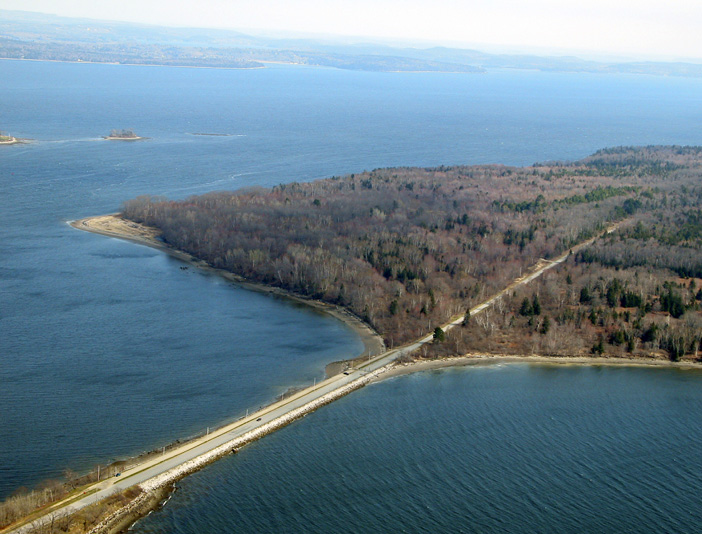
On January 11, just one day after one of the worst storms ever to hit the Maine coast, with another strong wind advisory on tap for January 13—and shortly after 2023 was declared the hottest year on record, the Bangor Daily News editorial board published an opinion piece promoting Sears Island as the preferred location for what many term an offshore wind (OSW) port.
(See https://www.bangordailynews.com/2024/01/11/opinion/editorials/maine-searsport-offshore-wind-port/).
The piece contains errors of fact and omits other crucially important information to arrive at their Sears Island conclusion. They are ignoring the fact that Sears Island, in its present undeveloped state, helps mitigate the effects of climate change that is not only threatening our coasts and oceans, but our very lives.
Climate change understandably and appropriately drives Maine’s OSW aspirations. Therefore, decisions about siting the OSW manufacturing, assembling, and launching facility must incorporate the multi-faceted public benefits of reducing atmospheric carbon dioxide, including lowering carbon emissions. In this situation, the clear choice in selecting a site for the wind port is to repurpose a former coal and fossil fuel site at Mack Point, which would retain the positive climate change benefits that the intact Sears Island wetlands and forest provides, such as carbon sequestration and environmental diversity.
The proposed industrial facility can NOT follow old-school economic development or business as usual thinking. It’s about responding immediately and thoughtfully to the climate crisis.
The Alliance for Sears Island and its allies first learned of the Maine Department of Transportation’s recommendation in 2021 to build an OSW facility on Sears Island, even though Mack Point was also identified as a viable option. Then as now, the facts conclude that an OSW manufacturing, assembling and launching facility should be built at Mack Point, not at Sears Island, if any such facility is built in Penobscot Bay.
The reasons for this conclusion are many.
- In 2007, the state of Maine agreed, by signing a Sears Island Planning Initiative consensus agreement, that “Mack Point shall be given preference as an alternative to port development on Sears Island.” The Sears Island Planning Initiative consensus agreement did NOT support industrialization of Sears Island.
- In February 1996, after a proposed cargo port proposal was withdrawn, controversy surrounded allocating funds for purchasing Sears Island. The Legislature’s eventual decision to allocate one-half of the purchase price did not include a commitment for any specific future use of Sears Island. As quoted in the March 29, 1997, edition of the Bangor Daily News, then Governor Angus King said, “This is an unusual piece of real estate. It is the largest undeveloped island on the coast of the United States. I see potential for it as a park or a port or both.” [Emphasis added]
- Sears Island’s current undeveloped, natural condition provides important ecological services to the region and state, especially for fisheries, carbon sequestration, and publicly accessible recreation. Mack Point does not provide these ecological services.
- Removing all vegetation from approximately 100 acres on Sears Island and then harvesting well over one million cubic yards of soil represent permanent, irreparable ecological damage, forever eliminating current upland and marine environmental benefits.
- Sears Island in its current undeveloped state supports several Maine Climate Council objectives. Two examples from the Maine Climate Council:
- “Protecting natural and working lands from development maintains their potential to draw back carbon from the atmosphere, as well as provide important co-benefits. Maine’s coastal and marine areas also store carbon, while supporting our fishing, aquaculture, and tourism industries.”
- “Develop policies by 2022 to ensure renewable energy project siting is streamlined and transparent while seeking to minimize impacts on natural and working lands and engaging key stakeholders.”
- Built-out at Mack Point consolidates industry in one 100-acre, segregated location, economizes on existing infrastructure and replaces and remediates Mack Point’s past outdated coal and oil history, likely making it eligible for additional federal funding from EPA’s RE-Power Program (https://www.epa.gov/re-powering).
We could go on. However, the take-away is that building an OSW facility in Penobscot Bay must:
- Pursue the least environmentally damaging plan,
- Favor repurposing outdated and unused industrial energy sites,
- Avoid damaging undeveloped and ecologically significant locations, and
- Evaluate thoroughly the impacts on climate change, wildlife and fisheries.
If Maine pursues building an OSW facility in Penobscot Bay, Mack Point is the preferred alternative because that location is best for business, best for the environment, and best for the State of Maine.
 Alliance for Sears Island