
A tremendous grassroots effort informed the Maine House of Representatives of the many good reasons to oppose LD 2266 – the sand dune bill – causing it to fail initially. However, after the Senate passed the bill, several Representatives changed vote so the second vote in the House approved the bill and sent it to the Governor for final adoption as law.
Representatives who stayed the course and upheld the vote opposing LD2266 should be thanked. Representatives who changed their vote for unknown reasons should be called-out for setting possibly one of the worst legal precedents imaginable. If any Maine Governor in the future thinks that a scientifically defensible environmental law challenges a development project, will they simply push through a new law exempting that project? Protect Wahsumkik and volunteers associated with Sierra Club Maine Chapter, as well as many Alliance allies and many of you reading this, performed an incredible job exposing LD2266’s blatant abuse of governmental authority and supporting protection of critical ecological features on Sears Island.
Although disappointed by passage of the bill allowing destruction of a sand dune on Sears Island, the central arguments involved in the Mack Point versus Sears Island offshore wind facility still hide in plain sight – it’s about Climate Change. The fundamental controversy revolves around making the best climate-change-informed offshore wind facility siting decision.
The recent Intergovernmental Panel on Climate Change (IPCC) Synthesis Report of 2023 understands that massive climate change developments, such as Maine’s proposed offshore wind manufacturing, assembling and launching facility, “play a crucial role in enabling and accelerating shifts in development pathways towards sustainability and climate resilient development.” [emphasis added]
All publicly available engineering and research about the proposed offshore wind hub in Searsport establishes that the sustainable, climate resilient development choice for the facility, if it’s to be built in Penobscot Bay, is on Mack Point and not on Sears Island.
For example, developing the offshore wind facility at Sears Island requires removing all vegetation and wildlife from some 75 or more upland acres, approximately 25% of which are significant freshwater wetlands, recently mapped and documented by Maine Department of Transportation’s consultants, that provide nutrients and habitat for both terrestrial and marine species. Developing the facility at Mack Point requires no or extremely little loss of wetlands.
By a FOAA request, Islesboro Islands Trust obtained documents delineating Sears Island freshwater wetlands by MDOT consultants. Mapped while planning geotechnical explorations in 2022 to avoid permitting concerns that illegally filled wetlands – known as the “earlier action” – might stall the explorations, the extensive wetlands reconfirm data from the 1990’s.
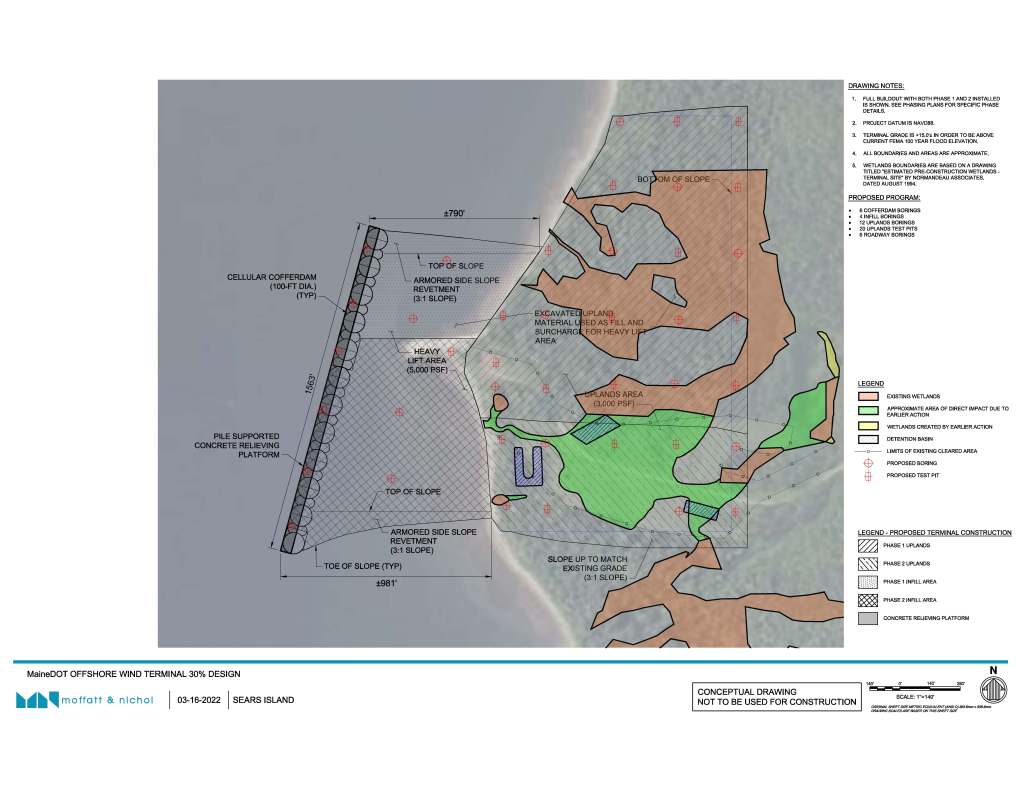
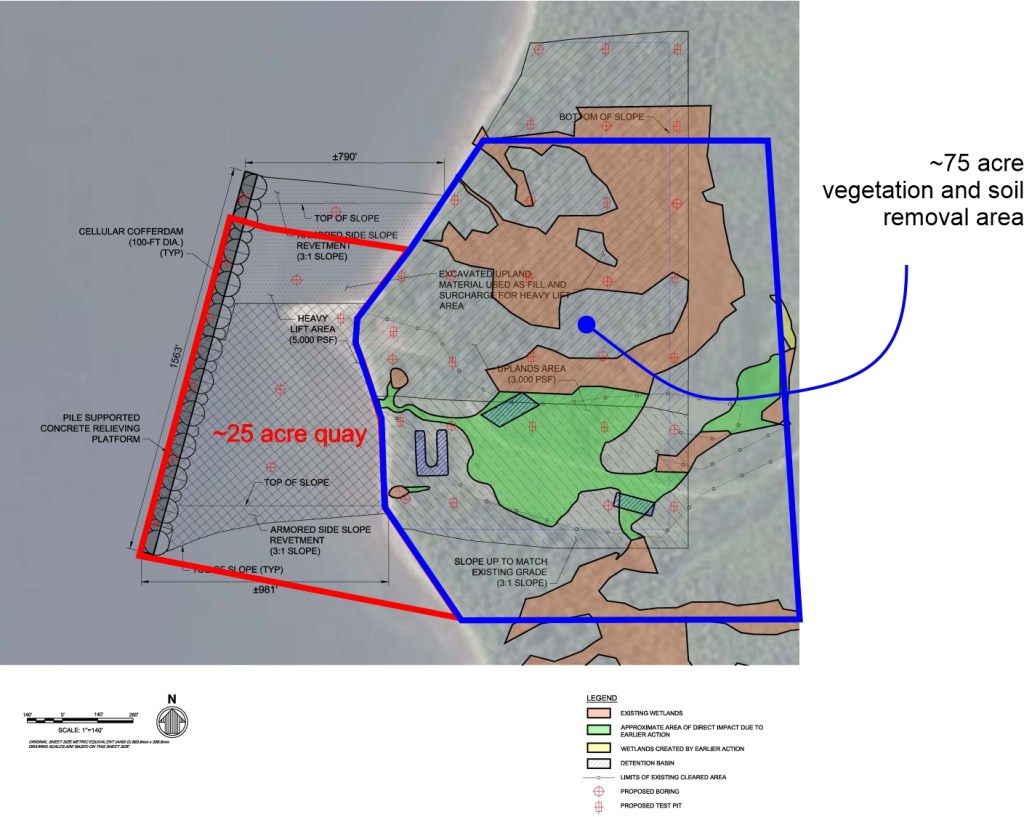
The initial 2022 delineation outlined the anticipated development area for reference (illustration 1), the proposed Sears Island development area increased thereafter. Therefore, IIT then laid the newest development boundary over the wetlands area (illustration 2).
Removal of significant Sears Island freshwater wetlands contradicts Maine’s “Promote Natural Climate Solutions and Increase Carbon Sequestration” policy clearly articulated in the Maine Won’t Wait (https://www.maine.gov/future/climate/council)) statement:
“There are significant opportunities for ongoing and increased carbon sequestration—including in Maine’s working forests and lands as well as ‘blue carbon’ in Maine’s coastal waters. Protecting Maine’s natural and working lands and waters helps store carbon while supporting our fishing, farming, forestry and outdoor recreation industries and providing important co-benefits, such as clean drinking water, important wildlife habitat, and helping to moderate severe flooding events. Access to lands and waters also has important health benefits and helps Mainers adapt to a changing climate, particularly those who are most vulnerable to climate impacts.” [emphasis added]
Yet we have Maine Governor Janet Mills and a host of others, including Rep. Marc Malon (D-Biddeford) offering, in a Portland Press Herald op-ed titled “Maine’s future depends on us saying ‘yes’ to forward-thinking climate projects,” the illogical opinion, “We need a port — and Sears Island is the most suitable location.”
Maine cites “preservation of high-value wetlands” as an important climate change policy. Mack Point offers an offshore wind development path forward that embraces wetland preservation, but developing the facility on Sears Island dramatically ignores that policy. Calling development of Sears Island a “forward-thinking climate project,” when the already industrialized Mack Point viable option sits just meters away, employs an extremely harmful logical fallacy of truly historic proportions.
Perhaps those who claim that Sears Island is the “least environmentally damaging” or “most suitable” location for the proposed facility have not researched the record and ecological implications of the location choice. See for example “Evaluation of the Significance of Impacts Sears Island Dry Cargo Terminal Searsport Maine” available at https://nepis.epa.gov/Exe/ZyPDF.cgi/94007OXR.PDF?Dockey=94007OXR.PDF.
“Biology, physics, Western social theory, and Indigenous scholarship all tell us that we are embedded in the natural world; to operate otherwise is a dangerous misconception and leads to the human-centered ecological crises we currently face.” (Caitlin Morgan et.al., University of California Press, Humans in/of/are nature: Re-embedding reality in sustainability sciences.)
Locating an offshore wind manufacturing, assembling and launching facility simply cannot use an outmoded, business-as-usual approach to decision-making. To get this decision right means fully embracing the indisputable fact that humans are part of nature. Totally removing all vegetation and wildlife from more than 75 acres on Sears Island, then harvesting more than one million cubic yards of soil where all that life once flourished, flies in the face of a climate change informed decision.
We understand that locating an offshore wind manufacturing facility on Sears Island has business appeal. The Sears Island site has room for expansion and deep water just offshore. But the ecological harm, the climate change harm from that development is far too great a price to pay for the convenience and desirability of business-as-usual. Not to mention the harm to the region’s environment-based economy if Sears Island development expands as proponents project.
All available expert engineering undertaken to date indisputably shows that a robust offshore wind manufacturing, assembling and launching facility can be built at Mack Point and that the facility there can achieve Maine’s laudable offshore wind objectives. The minimal dredging needed in no way compares to the devastation at Sears Island. Mack Point development reuses and repurposes legacy industrial land that offers little environmental benefit in its current state.
The clear choice, if we reject the “human-first, human-separate” mentality and approach the matter knowing humans are utterly, completely dependent on the vigorous web of life in the natural world, the clear choice is Mack Point.
Steve Miller
April 25, 2024
 Alliance for Sears Island