It’s not too late to change the course of the Sears Island offshore wind development debate. Understanding how humans fit into the grand scheme of life on planet earth, we can protect Sears Island and further offshore wind development at Mack Point.
Early in May, Derek Dunbar told Friends of Sears Island that he saw a young porcupine in a tree while walking on the island.
Derke wrote:
I noticed a baby Porcupine on the Island today. At first, I thought he was injured but realized he was napping. Worried that his mom had been killed, I contacted a wildlife group in South China. They told me that once porcupines grow their quills, they leave their mothers. The wildlife people said that, if we notice him in the same area or tree in a day or so, to contact them and they will come and get him. I was worried; he’s little and might not survive.

(Photo courtesy of Derek Dunbar)
However, the next day this critter was no longer in the tree.
Some of you may recall the Sears Island ermine, captured on video by Frank Norwood (aka Downeast Mike Productions) in January.
Whether it was the critter’s peaks of curiosity from behind and on top of the driftwood, or maybe those intelligent dark eyes, people were captivated by this iconic symbol of WahsamKik (Sears Island). Frank clearly found himself in the right place at the right time and had a camera ready!
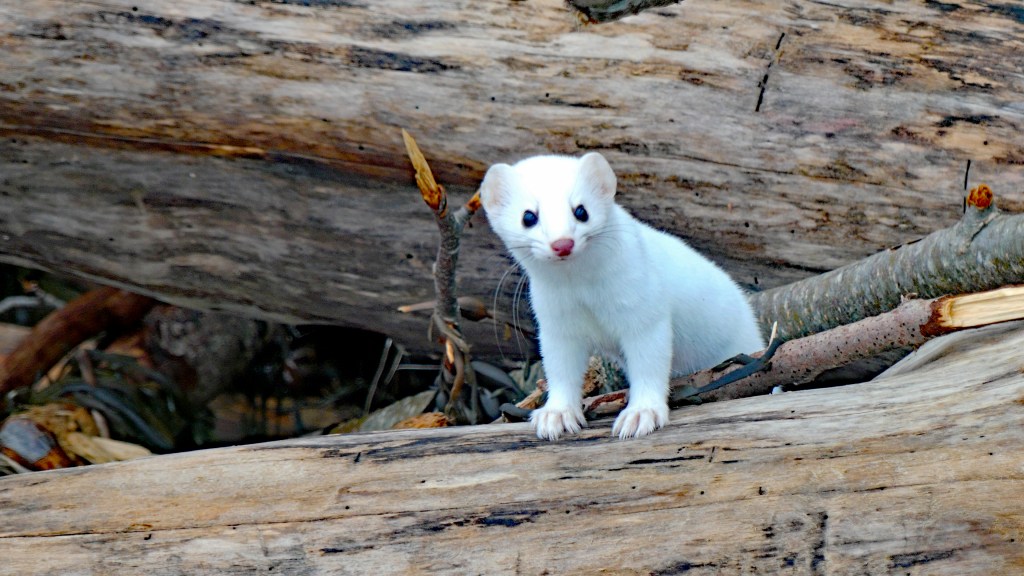
(Photo courtesy of Frank Norwood)
Sightings like these connect us with the world around us in many ways.
As the State of Maine, acting through its Department of Transportation, rushes to develop Sears Island instead of Mack Point for our most prominent response to climate change, we urgently need to scientifically, methodically assess options openly. Letting go of dogmatic, outdated economic development approaches to problem solving, climate change response demands that we bring all through-put and impact issues to the challenge and find what is right for the world. That will also be what is right for humans.
Offshore wind development plans for Sears Island offer destruction, rather than repurposing of land. Yesterday we might have justified erasing life – forest, wetlands, streams, soils, marine and terrestrial micro and macro-organisms – from an area on Sears Island because that was good for business and “made economic sense.” Today we know that attacking the earth, this sense of entitlement and willingness to exploit nature that so obviously ignores our fundamental connection to and with the earth, causes climate change, the very problem offshore wind is meant to help remedy.
An Alliance for Sears Island ally recently said, “We can not destroy intact ecosystems to pursue green energy.” Humans totally depend on a fully functioning environment. That’s a simple fact; not an opinion.
In an www.ecologicalcitizen.net piece, Derrick Jensen more strongly wrote:
“But I know that, as Lierre Keith has often said, ‘If there is anyone alive in a hundred years, they’re going to ask what the fuck was wrong with us that we didn’t fight like hell when the world was going down.’
“I know that life on this beautiful wonderful planet is at stake, and it’s time for us to fight harder than we ever thought possible. It’s time for every last one of us to pick up whatever tools or weapons or gifts that we have, and to use them, and to keep using them till our very last breath on this planet we call home.”
Finding our way through the overwhelming tragedy of earth in convulsions, ancient truths offer confidence and guidance.
“Here in the Northeastern Woodlands, the traditional Wabanaki people adhere to a set of core cultural values that are contained in our sacred way of life, what we call skejinawe bamousawakon. Central among these teachings is an understanding of the deep interrelatedness of the sacred and the secular.
“The Indigenous way of life reconnects humankind to the sources of its survival and the heart of its humanity.”
Sherri Mitchell, “Indigenous Prophecy and Mother Earth,” in All We Can Save, 2020.
Seeing Ermine and Porcupine while walking on Sears Island, breathing air that came through Forest’s carbon-scrubbing leaves, hearing Warblers sing in the woods, reminds us of how ecosystems actually work.
Steve Miller
 Alliance for Sears Island