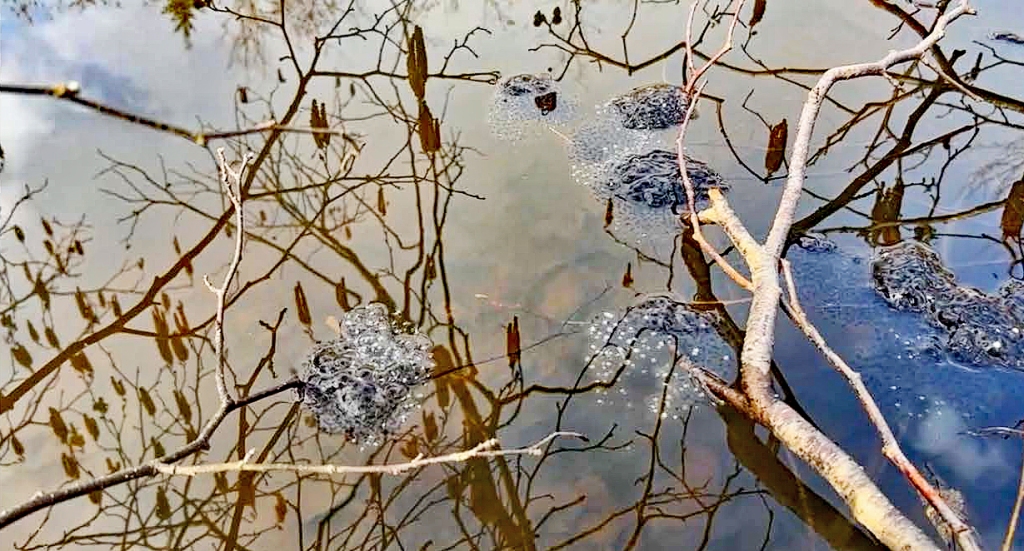
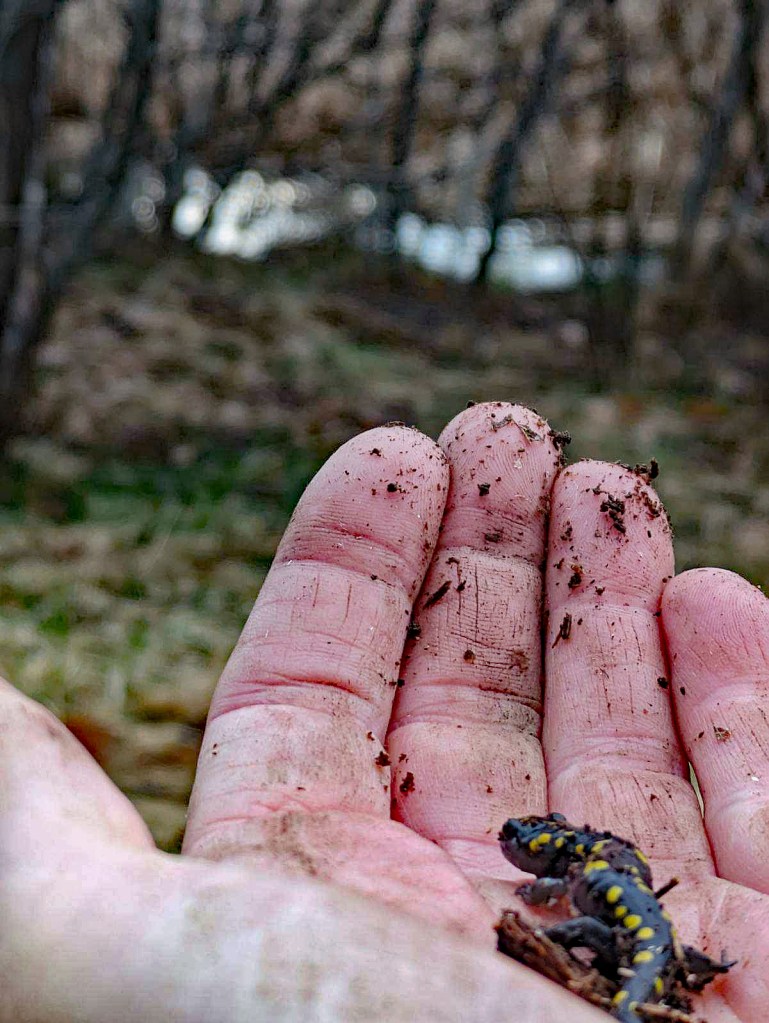
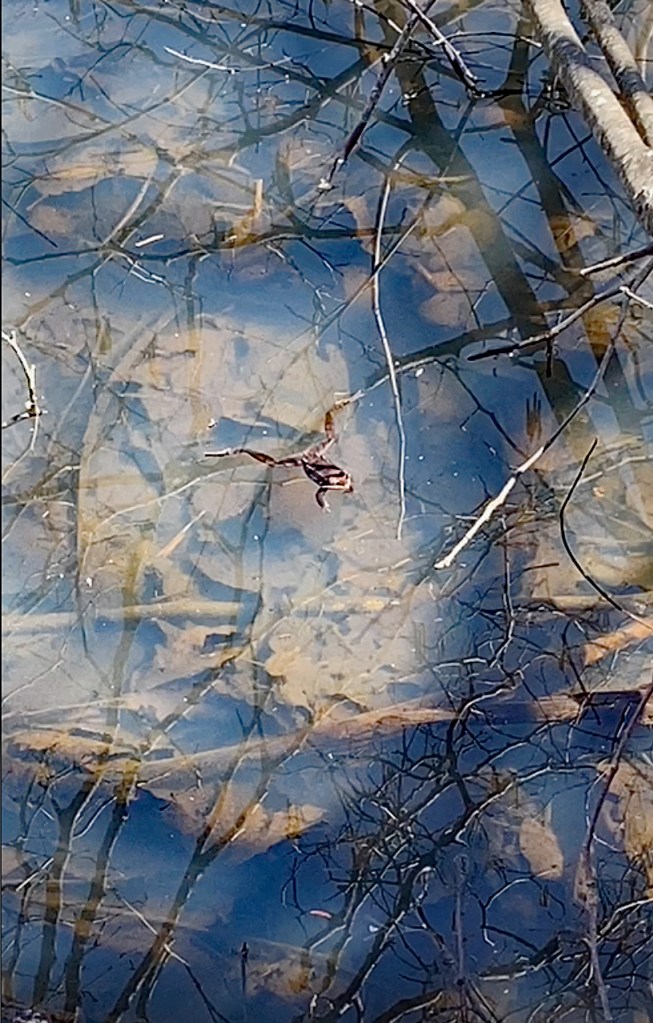
This past spring, two people went looking for spotted salamanders, wood frogs and egg masses on Sears Island as they and others have been doing for years. This year, of course, recording the presence of these species in vernal pools located where the Maine Department of Transportation (MDOT) wants to build an offshore wind manufacturing facility takes on a special significance.
According to the Maine Department of Environmental Protection (MDEP), “Significant vernal pool habitat is protected by law under the Natural Resources Protection Act (NRPA). An activity in, on, or over these areas must avoid unreasonable impacts on the significant vernal pool habitat.” ( https://www.maine.gov/dep/land/nrpa/vernalpools/fs-vernal_pools_intro.html )
Thoughtful, trained citizen scientists assist state agencies in numerous ways, providing “eyes on the ground” that a limited number of agency staff often simply can’t deliver. They often provide data to agencies, collected according to the agency’s protocols, that the agencies do not have the resources to obtain themselves.
According to an August 2007 report prepared for the Sears Island Planning Initiative by Lisa St. Hilaire from the Maine Natural Areas Program:
Three wetland pools were created in 1997 as [partial] mitigation for filling 4 ha of forested wetlands during preliminary site preparation (DES 1997, Vasconcelos and Calhoun 2006). These pools were monitored over a 5-year period to determine if the two Environmental Protection Agency stated measures of success were met within three years, specifically presence of breeding wood frogs and spotted salamanders and colonization by wetland vegetation, and to determine if the stated measures of success reflected longer-term reproductive success of wood frogs and spotted salamanders. Only one of the created pools replicated the desired seasonal water regime, the other two pools developed permanent and semi-permanent hydroperiods, allowing them to support populations of green frogs, a predator on wood frog eggs and embryos. Spotted salamander success was also reduced in these pools. Green frogs are not found in the natural vernal pools on Sears Island. This study suggested that monitoring of created seasonal pools continue for a minimum of 15 years, possibly more for created forested wetlands, before determining pool success (Vasconcelos and Cahoun 2006).
On April 13, 2024 two citizen scientists, one with degrees in both plant ecology and conservation biology and the other with long-term use of Sears Island for nature study, observed three vernal pools on MDOT’s Sears Island parcel, took pictures, and recorded their data following Maine State Vernal Pool Assessment protocols. They found 140 wood frog and 50 spotted salamander egg masses in one pool, 60 wood frog and 20 spotted salamander egg masses in another and 95 wood frog with 40 spotted salamander egg masses in the third pool.
According to Maine law, any one of or combination of the following species abundance levels, documented in any given year, determine the significance of a vernal pool: Spotted salamander presence of 20 or more egg masses and Wood frog presence of 40 or more egg masses (See Maine Department of Environmental Protection Rules 06-096 C.M.R. Ch. 335, Section 9 B (1) (2014)). The optimal time for counting the eggs for such a determination is approximately April 25 to May 25 depending on the species.
However, Maine Inland Fish and Wildlife (MIFW), the state agency responsible for recording significant vernal pools, bounced the documented observations of significant vernal pools on Sears Island within the so-called transportation parcel back to the two citizen scientists, requesting proof that the Maine Department of Transportation provided permission to access the property.
When the two citizen scientists asked MDOT to verify that vernal pool observation was allowed on the transportation parcel until any development there receives necessary permits, they received the following reply:
MaineDOT hired a qualified consultant to complete vernal pool surveys on this parcel this spring as well. We are looking at the data that they collected to compare to your information. For consistency, we prefer to used our qualified consultants information for submittal on these pools to IF+W.
The Sears Island Planning Initiative (SIPI) Consensus Agreement of 2007 (see linked page 3) clearly and unambiguously says that, “Uses currently occurring in the area reserved for the port development shall continue to be allowed in that area until such time as a port proposal completes the regulatory process.” Conservation activities such as the identification of vernal pools appear to be clearly included in such uses, as the MDOT parcel abuts and is ecologically connected to a significant conservation easement.
Meanwhile, we do not know whether the MDOT consultant data referenced above is the same as a report undertaken by VHB and attached to the MDOT federal Transportation Agency grant application. However, page 9 of the “Wetland Delineation Report, Sears Island Study Area, Searsport, Maine” Prepared for MaineDOT by VHB, January 2024, reports that, “VHB did not identify any potential vernal pools within the Study Area.”
MDOT appears poised to accept one set of vernal pool observations and reject another, giving preference to its own hired consultants. MDOT may have good reason to compare two sets of vernal pool observation but we see no reason to prefer or exclude one well documented set of observations over another. Instead, good science would suggest that BOTH sets of observations should be accepted and adopted according to MDEP and MIFW policy until or unless an impartial, third-party can confirm or deny the existence of significant vernal pools in the proposed Sears Island development area.
Is this yet another instance of MDOT failing to honor a promise made in the SIPI Consensus Agreement? Why should Inland Fish and Wildlife require more proof of permission to access Sears Island than that explicitly provided in the SIPI agreement? On what basis of authority can MDOT reject accurately documented significant vernal pools?
This appears to be another classic but familiar case of the fox guarding the henhouse in MDOT’s approach of avoiding inconvenient environmental issues to expedite permitting for their intended Sears Island development. Recently, they were successful, with the Governor’s Office’s support, in legislating away NRPA protection of an important sand dune at Sears Island. In addition, MDOT appears poised to alter inconvenient terms of the Sears Island conservation easement.
Significant vernal pools remain protected under NRPA and MDOT must comply with NRPA’s statutory and regulatory requirements. Whether or not it chooses to do so remains to be seen.
Steve Miller
 Alliance for Sears Island