In retrospect, I suppose it went pretty much as one might expect.
Town Manager James Gilway explained the format and introduced Matthew Burns, Executive Director of Maine Port Authority (MPA). Burns thanked the Board for the invitation and said he was happy for the opportunity and would be available for future meetings to answer questions (as if the Board hasn’t been pressing MDOT for a meeting for two years). He explained that as MPA director, he wasn’t really with MDOT anymore but because of his previous role in MDOT, and his intense interest in all thing’s ports, he continues technical knowledge of the project and the process. (This allowed him to duck a few sensitive, “non-technical” questions). He failed to mention that MPA is a MDOT agency.
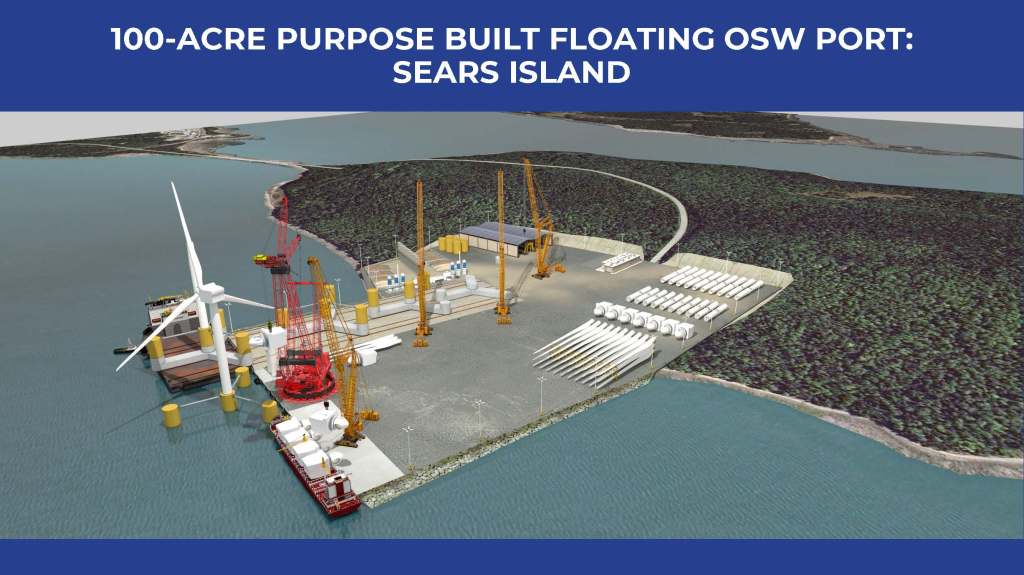
Matt Burns’s slide deck, almost entirely full of minutiae, seemed designed to eat up half the allotted 2-hour meeting time. Budgets, timelines, milestones and contradictions (lies?). For example, one slide with a rendering of the facility showed the current road, the next slide showed the new road. His explanation – they are thinking about a new heavy load road and space for a rail line on the transportation parcel but haven’t decided yet. In response to a later question, he said it would add $10 million to the cost but since no permitting consideration has been given yet they didn’t know the wetlands impacts.
About 34 minutes into his time eating presentation, a member of the audience started to heckle him rather loudly for the tactic. Burns went silent and the Select Board members seemed stunned. The Chair threatened removal and the protester was silenced. For about 10 minutes. Then the heckler started shouting about Wasumkik. They left when Gilway rose and approached, seemingly to escort them out.
The presentation droned on for another 20 minutes. When it finally came to the questions, Burns managed to dodge or diffuse several of them. He said MDOT will accept the vernal pool observations and add them to their datasets, as would Fish and Wildlife, but he also asserted that permission for such studies is required.
In response to questions about the Sprague plan, Burns said that MDOT would now devote some resources to examining the plan, its costs, etc. This limited his need or ability to comment on that alternative analysis. He did say that the Sears Island plan offered the necessary rectangle shaped layout that Sprague’s didn’t. The lease issue was mentioned and that “because we own the property” is still a primary motivation to develop Sears Island.
He couldn’t answer several questions because they are still awaiting numerous studies on economic impact, housing impacts, lighting requirements, community impacts and a few other studies.
He said that divers, who worked for two days in December, observed lots of sea urchins, but very few lobsters. He also stated they found no eelgrass beds.
It is worth mentioning that in his timeline he showed the Alternative Analysis complete in 3Q 2024 and permitting in 4Q because, when asked if they would commit to providing the public with sufficient time to review the Alternative Analysis before permit applications that would start the time-limited scoping process, he stated that the Alternative Analysis would be submitted with the permit applications. However, a handout available at the meeting stated, “the Alternative Analysis is expected to be finished and submitted to agencies for comment in September 2024. Not the public.”
After the meeting I approached Doug Norman, Select Board Chair, and he volunteered how disappointed he was in Burn’s presentation and how he focused on Sears Island to the exclusion of Mack Point.
My key takeaway is the inference that MDOT is planning a blitzkrieg of permit applications, State and Federal, when they get the results of their grant applications.
We need to be prepared. We need a class in how to engage in the permitting scoping process, including writing appropriate letters, to the greatest effect.
David Italiaander
 Alliance for Sears Island