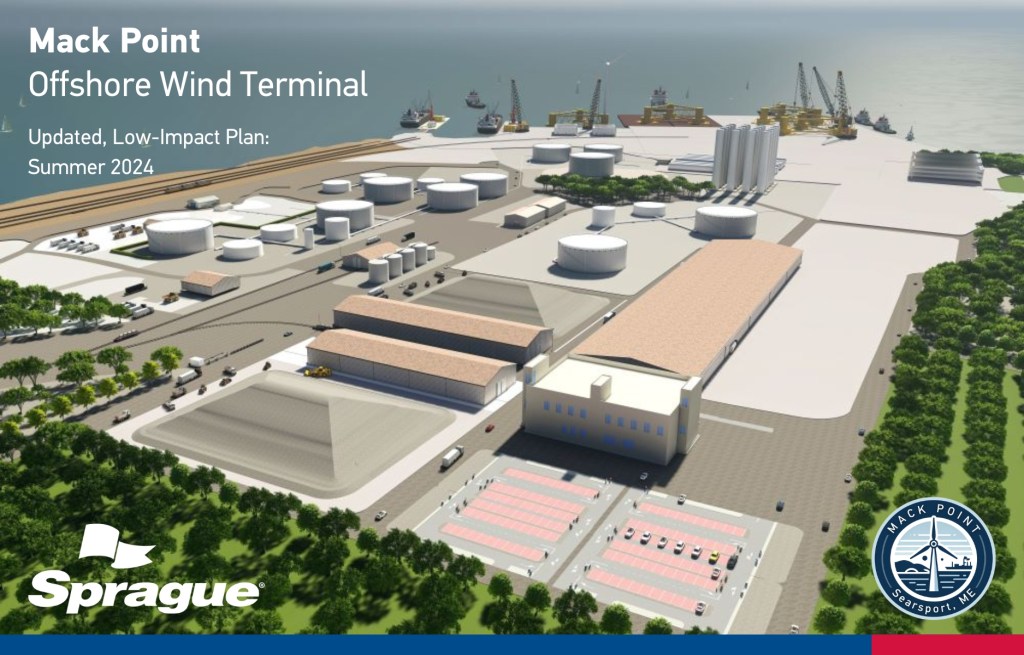
| As the State of Maine reels from yet another denial of federal funds to support the development of an Offshore Wind Port (OSWP) on Sears Island, it is important to contemplate the significant cost of such a project to the taxpayers of Maine in addition to the costs of this project on the environment of Penobscot Bay. Taxpayer Costs Efforts to develop Sears Island have cost taxpayers more than $26 million over the years.1 The State of Maine has already spent over $4 million on the current wind port effort; a project which is not supported by a majority of the community, is unlikely to meet the regulatory hurdles, and relies on untested technology. Numerous attempts by Maine DOT and the Governor’s Energy Office seeking federal funding have repeatedly failed. This leaves a difficult to address massive funding gap that could ultimately result in the people of Maine carrying the financial burden. Even the CEO of Diamond Offshore Wind, a subsidiary of Mitsubishi and principal behind the development of the project, suggested that Maine should “relinquish the dream of being the premier offshore wind port of the Eastern Seaboard and focus on the research array.” Behind the Push to Develop Sears Island So why is the State pushing so hard to develop one of Maine’s last undeveloped islands? The answer is plain and simple. The State of Maine and the Mills Administration’s attempts to develop a port in Searsport, purportedly an effort to provide renewable energy and address the climate crisis, in fact simply furthers Maine Department of Transportation’s long-standing efforts to industrialize Penobscot Bay. This will result in destructive industrial activity on the shores of Penobscot Bay that will eliminate carbon sequestering ecosystems, and will not mitigate the climate crisis. According to the Alternatives Analysis (AA), “a port facility that can accommodate only a single use or certain type of floating OSW technology will have limited practical use. In contrast, an adaptable well-designed OSWP will be capable of attracting a wide range of potential OSW project developers and accommodate a range of technologies, thereby maximizing the benefits of the State’s significant investment of resources.” The AA continues, “a port designed for FOSW can support all other forms of marine port usage. This includes containers, bulk cargo, out of gauge cargo and automobiles.” Environmental Costs Absent from the AA conducted by the State are the costs associated with upgrading the causeway to Sears Island, which is failing, was likely constructed illegally and cannot support the heavy-load traffic the proposed facility would require. Similarly, there is no reference to the cost of constructing a rail line to Sears Island or a new access corridor on the island, both of which will be needed for the project to be successful. The Alternatives Analysis refers to the cost of retrofitting Mack Point, a preferable alternative for an untested technology, but it does not consider the true costs of the State’s Sears Island proposal, “…cost is also a key factor that limits available alternatives. One driver of project costs is the availability of land. Another significant and costly challenge at Mack Point is the presence and location of Canadian Pacific-Kansas City Railway (CPKC) trackage in the terminal… this would require the relocation of the existing track, the cost of which is currently unknown.” Yet, according to Sprague Energy who operates the current Mack Point facility, this rail trackage does NOT need to be relocated. While the State of Maine proudly touts the merits of the “Maine Can’t Wait” climate action plan, it blatantly proposes a project that would severely impact key coastal wetlands and habitats that are critical to mitigating the impacts of a changing climate. |
 |
| Repurpose and Renew The State of Maine is missing an incredible opportunity to not only lead the way in renewable energy production, but to also remediate possible legacy fossil fuel impacts at Mack Point. Instead, the State, in its AA, considers this type of clean-up of a former fossil fuel site an additional cost, “there are other unknown construction elements that could add to costs at a given site, including but not limited to potential contamination and remediation. Several locations evaluated in this section are on active industrial sites with expected contamination. The State has not conducted investigations at each of these sites to determine the type and extent of contamination. The potential for contamination and remediation is addressed qualitatively as an element that adds uncertainty to schedule and likely an increase in costs.“ As we continue to seek alternatives to our consumption of fossil fuels and the inevitability of a changing climate, we must first answer some very basic questions. First and foremost: What is needed? Does Maine need an offshore wind port on Sears Island, in support of an untested technology, when most of the power generated would serve other areas in New England and severely impact Penobscot Bay and the Gulf of Maine? Have we exhausted other methods of decreasing our energy consumption through broad energy conservation measures, rooftop solar, and other means? Pete Nichols |
- The State of Maine, acting through its Department of Transportation, spent $26 million in Sears Island development efforts, as reported at the October 20, 2006 Sears Island Planning Initiative meeting, in answer to the question, “What have been the real costs to taxpayers so far?” ↩︎
 Alliance for Sears Island