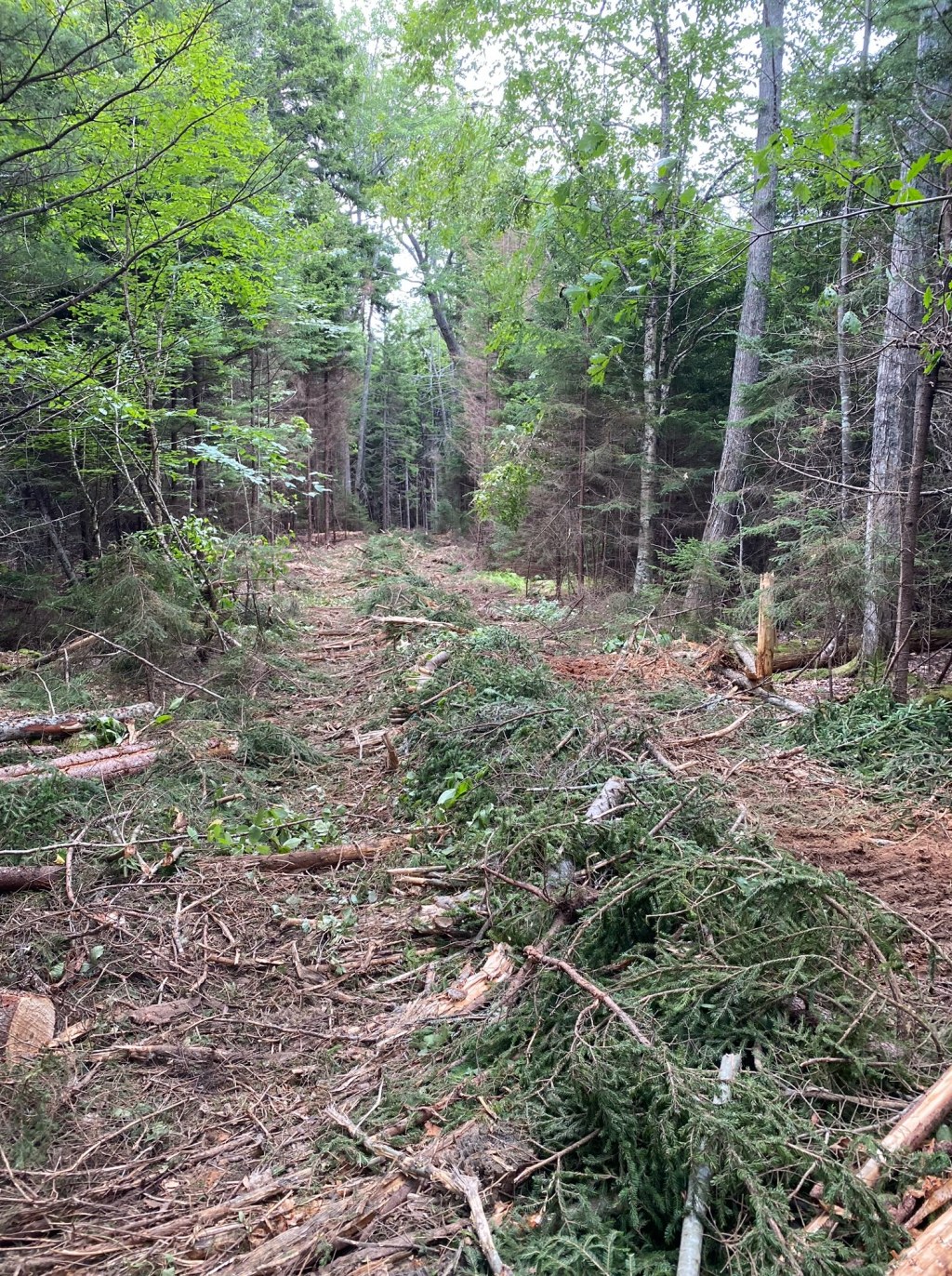
Photo of tree removal in the proposed Sears Island development area taken in 2022 during geotechnical explorations there. Photo by Rolf Olsen
[Editor’s Note: This piece is the third in our series on issues raised or missing from the Draft Alternatives Analysis. That AA failed to even consider the effects on carbon sequestration or carbon emissions from developing Sears Island compared to Mack Point.]
Preserving the mature forests that exist today on Sears Island is an important contribution toward reaching Maine’s goal to be carbon-neutral by 2045. The State of Maine’s Carbon Budget, Version 2.0, identifies forestland as the most significant factor removing greenhouse gases from the atmosphere through carbon sequestration.
Carbon sequestration is the process of removing carbon dioxide from the atmosphere and storing it in plants. All green plants remove carbon from the atmosphere through photosynthesis, absorbing carbon dioxide (CO2) from the air, combining it with water and energy from the Sun and releasing the life-giving oxygen we all need to breathe. The carbon stays in the plants as building blocks for growth. The trunks of towering white pines were built from tiny molecules of CO2 pulled from the air.
The proposal for developing the wind port on Sears Island involves clearing and grading a minimum of 78 acres of the island with 70 of those acres now supporting a mature forest. The Nature Conservancy’s Resilient Land Mapping Tool estimates the mass of carbon stored in forests. Destroying those 70 acres of forest in 2026 would ultimately release 6,727 metric tons of carbon into the atmosphere – carbon that is currently stored in the forest – the equivalent of adding over 5,600 gas-powered cars to the road. (each average car annually emits 4.6 metric tons of carbon dioxide which equals 1.2 metric tons of carbon) Instead, allowing those 70 acres of forest to continue to grow and remove carbon from the atmosphere would sequester a total of 7,320 metric tons of carbon by 2050.
Carbon sequestration in intact ecosystems is a proven and cost-effective method to remove CO2 from the atmosphere and mitigate ongoing greenhouse gas emissions. Deforestation and wetland loss are key factors that reduce natural carbon sequestration.
D. Kopec January 2025
 Alliance for Sears Island