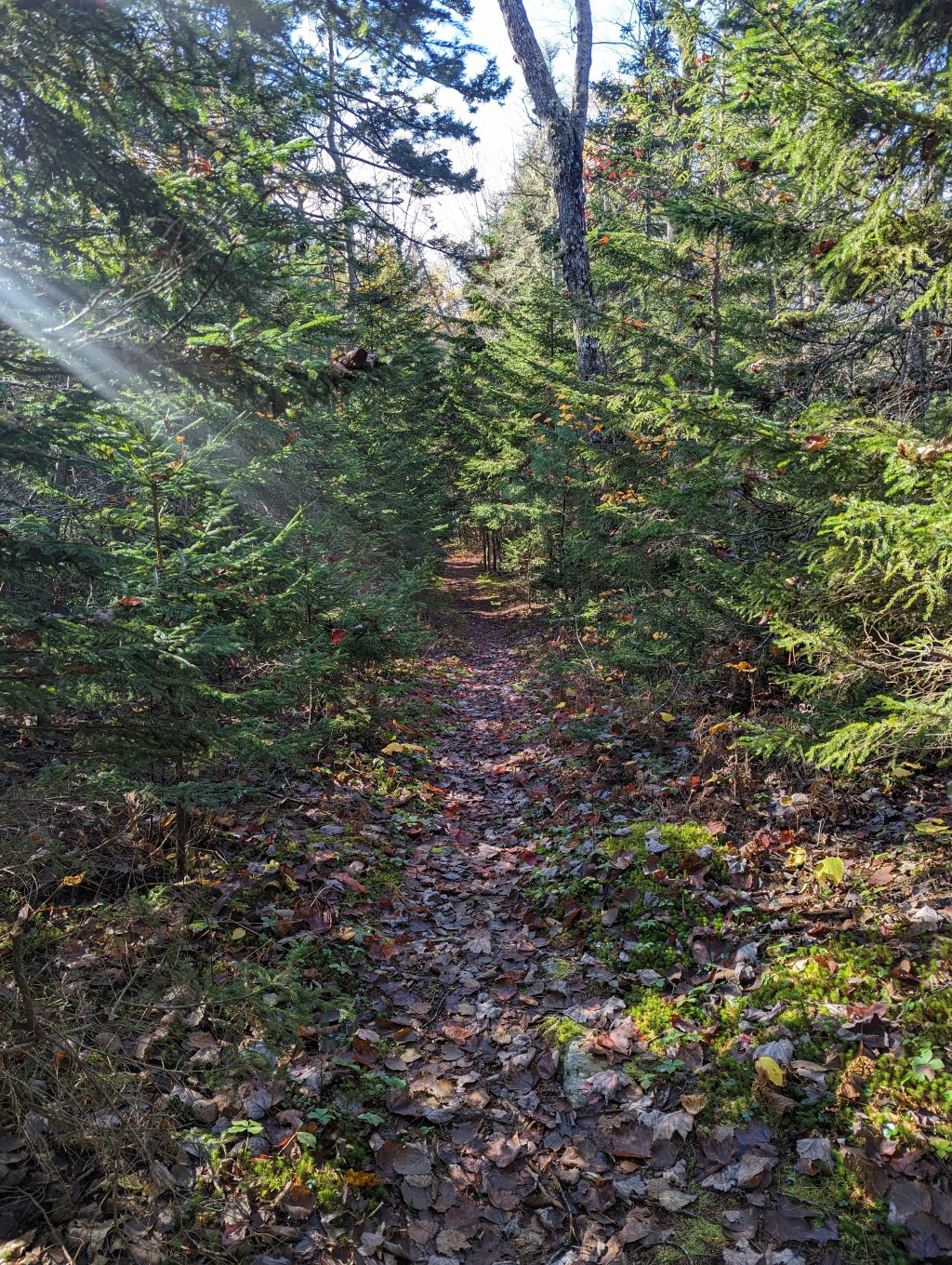
Harvesting Soil
Editor’s Note: This piece is the fifth in our series on issues raised or missing from the Draft Alternatives Analysis (the AA). The Maine Department of Transportation (MDOT) Sears Island development plan would “harvest” (remove) more than two million cubic yards of soil from the upland development site.
Extent of Damage
According to MDOT consultant Moffat and Nichol’s “Sears Island FOSW Port- Description of project,” the proposed Sears Island development requires “cutting into the hillside to remove” 2,126,000 cubic yards of soil. The removal of more than 2 million cubic yards of soil from an area some 3.5 million square feet in size, starting at the edge of Penobscot Bay and extending up a point 70-90 feet above sea-level, represents unprecedented environmental damage.
It’s difficult to comprehend the scope of such an excavation. One way to visualize the size of this crater on Sears Island’s western shore – you could fit two-and-a-half buildings the size of the TD Garden in Boston into the cavern. Or you could fill 141,723 large, three-axle dump trucks with the harvested soil that, if lined up, would stretch from Searsport to Portsmouth.
The Draft Alternatives Analysis attempts to hide the immense impact of this soil extraction by focusing on the cost of removing some of this soil from the island. The AA reports that some 1,686,000 cubic yards of the excavated soil would be used as fill for the quay extending out into Penobscot Bay and that, “Based on a cut and fill analysis, a net export of 440,000 CY is anticipated for the preferred Sears Island layout,”

Sears Island Development Area Jill Howell Photo
Soil Matters
The Maine Geological Survey reports that the last glacier to cover Maine began to recede 21,000 years ago and that the coast, including Sears Island, was clear of ice and ocean some 12,000 years in the past. This means that thousands of years ago the soil MDOT proposes to remove from Sears Island began the dynamic process of combining minerals, organic matter, air, freshwater and life forms under the watchful eyes of the Penobscot Nation ancestors known as People of the Dawn, wooly mammoths, giant beavers, and ancient tundra vegetation.
Over the course of these several thousand years, the soil to be removed from Sears Island created a powerful living ecosystem on the island, what some call a “living skin.” The Earth Microbiome Project finds that “there are hundred-of-thousands of species in a handful of healthy soil.” National Geographic soil scientists report that this massive number of species in soil, “all interact to keep their soil habitat healthy and productive.”
Soil captures climate changing carbon and in aggregate reportedly holds more carbon than all terrestrial plant life on the planet.
Research titled, “The role of soil in defining planetary boundaries and the safe operating space for humanity,” reports that “soils are one of the most complex and diverse ecosystems in the world, hosting a quarter of the planet’s total biodiversity.” The report explains that, “Soil simultaneously acts as both a source and sink of CO2, and thus plays a critical role in climate change.”
This research concluded, “Soils are a master variable for regulating the critical Earth-system processes within the planetary boundaries framework, with no other single variable playing such a strategic role across a broad range of the Earth-system processes.”
Compared to Mack Point
The Sprague Alternative for offshore wind development at Mack Point requires very little soil disturbance and the already compacted, industrial soil that would need to be moved contains a far less robust ecosystem than the undisturbed soils on Sears Island.
Broken State Promise
This understanding of the vital role soil plays for humans and the planet prompted agreement among those involved in the Sears Island Planning Initiative (SIPI) that no soil harvesting should ever occur on Sears Island. During Offshore Wind Port Advisory Group meetings, MDOT representatives repeatedly promised to uphold the SIPI agreement when siting an offshore wind manufacturing facility. MDOT representatives now ignore that unequivocal agreement to never harvest soil on Sears Island.
Unusually Deep Sears Island Soil
Soil in the Sears Island development area appears to be unusually deep for a coastal site where bedrock is often present at or near the surface. The Maine Geological Survey of Sears Island reports finding, “till greater than 78 feet deep on the western shore.” The “Natural Resource Inventory” compiled for Friends of Sears Island by Alison Dibble and Jake Maier observed that this unusual depth of soil “suggests that tree growth may benefit from unusually deep root penetration, compared to other coastal sites…”
Construction nears completion of the University of Idaho’s $25 million Deep Soil Ecotron, created to better understand the role of deep soil “across multiple systems” in addressing human health and sustainable energy.
Image the stories that Sears Island’s thousands-of-years-old, uniquely deep coastal soil could tell. This soil witnessed now-extinct mammals roaming a tree-less tundra after the glacier retreat, rising and falling ocean levels, ancient human tribes sharing sustenance in the species-rich environment, forest communities rising from organic deposits. Sears Island soil deserves respect and appreciation. It epitomizes deep ecology.
Conclusion
The extent of soil removal at Sears Island to accommodate the proposed manufacturing facility there, and the ecological significance of that soil, rises to the top or near the top of the long list of reasons why Maine should prefer Mack Point for an offshore wind manufacturing site, not Sears Island, if any such facility is built in Penobscot Bay.
Isn’t it time to re-calibrate Maine’s offshore wind plans?
Steve Miller

Kevin Shields Photo
 Alliance for Sears Island