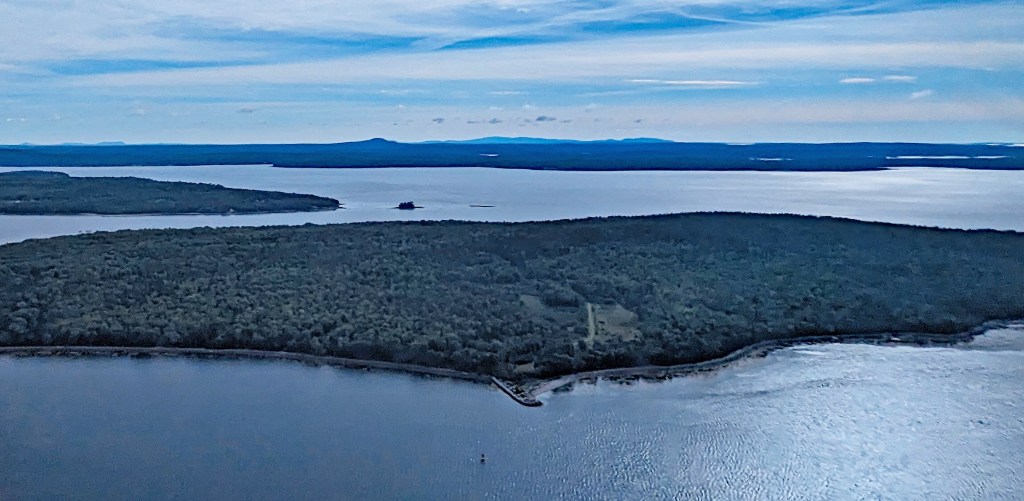
The Alliance for Sears Island recently adopted a new mission statement:
“We support permanent conservation of all of Sears Island, and we support the development of a wind port facility at Mack Point, if any such facility is to be built in Penobscot Bay.”
This shift in focus, from opposing construction of a wind port on Sears Island to advocating for the permanent conservation of the entire Island, recognizes the history of proposed industrialization of the Island and Maine DOT’s ultimate plans for Sears Island.
Until the last 60 years or so, Sears Island thrived in an almost natural state, largely protected by intermittent tidal access. Called wahsumkik by the Penobscot Nation, the Island is part of the homelands of the Nation and is located at the mouth of their river of origin. Penobscot people used the island as a base for hunting, fishing, and resting along paddling routes. After colonization, the island was farmed and used as pasture for animals through the 1800s.
The threat of irreversible industrial development began in the late 1960s with the proposal of an aluminum smelter, one of the most polluting types of manufacturing. Despite the island’s isolation from the mainland, public opposition ended plans for a smelter. In 1971, an oil desulfurization refinery was proposed, designed to handle sour crude oil destined for Boston. Local opposition was again strong and no refinery was built. During the 1970s, a number of industries were brought forth; in 1975, local voters approved Central Maine Power’s plan to build a nuclear power plant on the Island, though a geologic fault line near the Island proved too unstable to support a nuclear reactor. In the late 1970s, a coal-fired power plant was proposed and again withdrawn due to public opposition. For 15 years, beginning in the 1980s, the state worked to move forward with a container port on the western side of Sears Island. Opposition from locals and the Sierra Club slowed the port development and the presence of valuable wetlands and eel grass beds identified by the Environmental Protection Agency during their review further damaged the proposal. In the late 1980s, the State of Maine took 50 acres of the island by eminent domain, and bought most of the remainder of the Island in 1997.
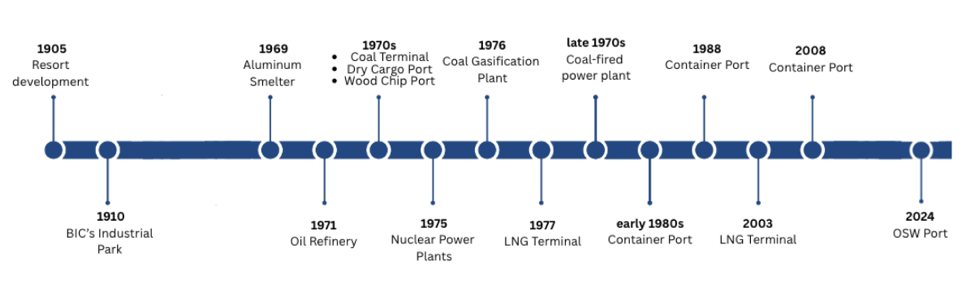
Despite the opposition and court injunctions, the State built a solid causeway connecting the Island to the mainland in 1988, ignoring permit requirements for culverts and the habitat needs of the intertidal community, and blocking the natural flow between Stockton Harbor on the east and Long Cove on the west side of the causeway. During this period, the State also dredged a 40 foot deep “dredge pocket” off the western shore of Sears Island, in anticipation of port construction. Additionally, MDOT illegally filled ~10 acres of freshwater wetlands on the island during construction of the causeway. A lawsuit was filed against DOT for violations of the Clean Water Act, which resulted in a settlement with EPA that included a $10,000 civil penalty and $700,000 for environmental mitigation projects. In 1996, Governor King abandoned the effort due to ongoing environmental issues and cost projections.
In the mid-2000s, the Sears Island Planning Initiative (SIPI) brought together community members, local and state officials, environmental organizations, and members of the business community to discuss the future of the Island. The SIPI consensus agreement reached in 2007 prohibited any port development on the 300-acre western portion of the Island unless “an alternatives analysis documents the need (for a cargo port) could not be met elsewhere.” Mack Point was also to “be given preference as an alternative to port development on Sears Island.” An accurate interpretation of that agreement has proven to be elusive.
By 2020, in recognition of the growing climate crisis and the need to reduce Maine’s emissions of greenhouse gases, the State Energy Office announced the goal of 100% renewable electricity by 2040. This plan included 3 gigawatts of electricity generated annually by floating offshore wind turbines in the Gulf of Maine. Construction and servicing the planned 150 20-megawatt wind turbines required a dedicated wind port built along the Maine coast. In February of 2024, after deliberations by the Offshore Wind Port Advisory Group convened by the state in 2022, Governor Mills chose Sears Island as the preferred location for Maine’s offshore wind port. A number of state-wide environmental organizations stood with the Governor when she announced the choice of Sears Island for the wind port, despite their past opposition to industrial development on the Island. The wind port was championed by some as a critical response to the climate crisis, while ignoring the option of building a wind port on Mack Point.
Yet was the choice to site a wind port on Sears Island a back door into widely opposed industrialization of the Island? Clearly, support for offshore wind energy by state-wide groups has silenced their past opposition to industrialization of any part of Sears Island. What happens to the port development if offshore wind does not become a reality?
The State has already thought ahead. Maine DOT’s 2024 Pre-Application Alternatives Analysis, State of Maine Offshore Wind Port describes how the port site would be used in the absence of a wind port. In Section 4.1 the port is described as a long-term asset which “…can support all other forms of marine port usage. This includes containers, bulk cargo, out of gauge cargo and automobiles.” The report goes on to say that the proposed offshore wind port would “support alternative marine transportation uses, consistent with the JUPC Consensus Agreement (2007), between OSW projects or after OSW development…”, despite the wide interpretation of that Consensus Agreement that any OSW port on Sears Island, when Mack Point is available, violates that agreement.
Then, in March 2025, during testimony on LD 226 and LD 735 before the Environment and Natural Resources Committee, Matt Burns, the Deputy Director of Freight and Business at Maine DOT, was asked by Representative Bridgeo: “even though the current intent is the development of an offshore wind (port) for this site, it remains the case…should that in the future prove to be not doable, that the opportunity is preserved for other forms of economic development for the state on this property?” “Yes sir, that is correct …to have the ability to develop the port in the future I think is important to the State of Maine,” replied Burns. He went on to expand his answer: “it would be entirely possible to be able to use that port facility for other types of commodities, whether it was roll on, roll off, cargo, container.”
The new mission statement by the Alliance for Sears Island recognizes that the OSW port is not the only threat to Sears Island, but rather just one proposal in a long history of attempts by the State to industrialize the island that will continue to be brought forth unless and until the entire island is permanently conserved. This is not a NIMBY (not-in-my-back-yard) issue; the Alliance for Sears Island has always supported the development of an OSW port at Mack Point, which lies just 800 meters to the west of Sears Island. Instead, we recognize the critical need to preserve undeveloped Sears Island as critical habitat for future generations of humans and wildlife.
Authored by Dianne Kopec
 Alliance for Sears Island