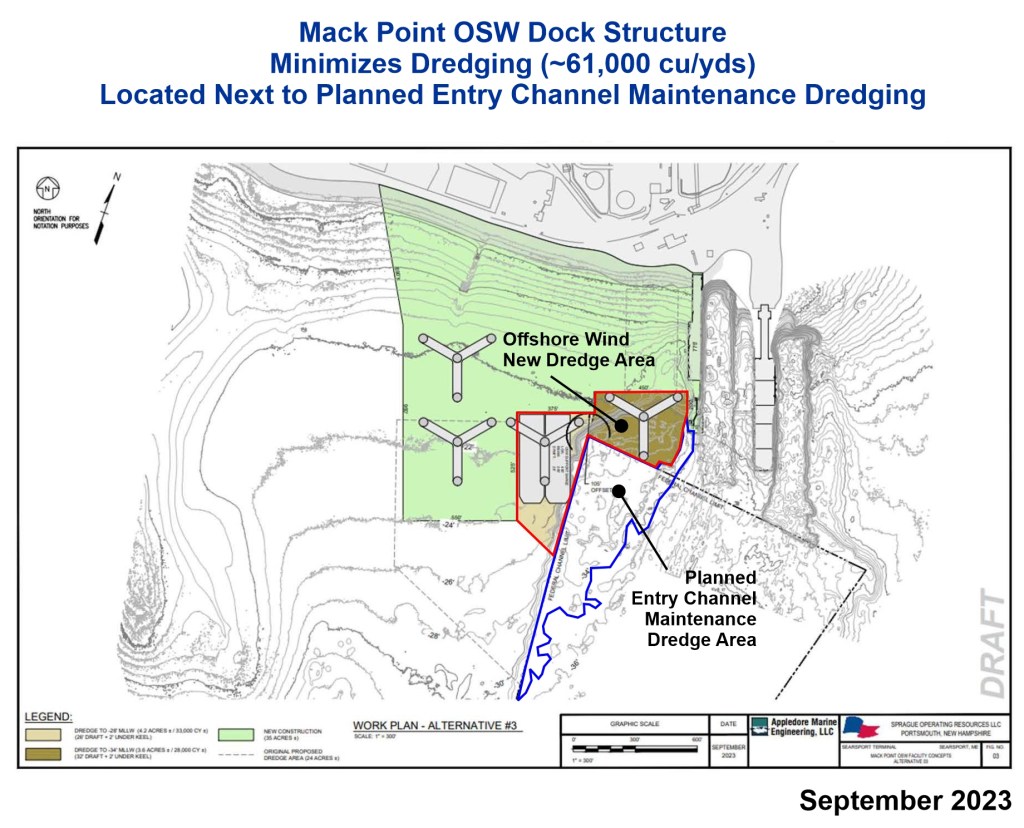
You probably read recently that Mack Point needs dredging to develop an offshore wind manufacturing, assembling and launching facility there and that such dredging renders Mack Point unsuitable or undesireable for the facility. Even the Governor, when announcing the state’s decision to build on Sears Island, said, “Unlike adjacent Mack Point, the Sears Island site is not expected to require dredging, a key environmental and financial consideration for a port project.”
But is the needed Mack Point dredging really such a major problem? And how does the Mack Point dredging compare to the environmental destruction required to pursue the facility at Sears Island?
Sprague Energy hired an engineering consultant to create an offshore wind (OSW) concept for Mack Point. Their analysis and concept plan concluded that only 61,000 cubic yards or less of sediment would need to be lifted to accommodate the OSW facility.
The dredging itself would be done using best practice environmental safeguards (sediment curtains, walls, etc.) commensurate with any actual contamination found in the sediments to be dredged. The Mack Point offshore wind dredging area is located immediately adjacent to a federal Mack Point entry channel.
Maintenance dredging of approximately 40,000 cubic yards from a corner of the channel, which we do not oppose, has been discussed for quite some time and remains on the Army Corps of Engineers as a pending project. According to MDOT, sediment samples from the maintenance dredging area in the federal channel were analyzed and showed “chemical concentrations of the sediment below required Maine Department of Environmental Protection (Maine DEP), Army Corp of Engineers (ACOE), and US Environmental Protection Agency (USEPA) screening levels for beneficial reuse.”
Until sediment samples are taken from this 61,000 cubic yard area, it seems reasonable to assume the test results will be similar to those in the immediately adjacent sediment.
Even if some contamination of these sediments exists, removal can be undertaken with modern techniques that prevent resuspension and, so long as that sediment is disposed to prevent further biological availability, the net result would be environmentally neutral.
Dredge spoils, according to the 2021 Moffatt and Nichol report, might be used as backfill behind the Mack Point quay, where the spoils would no longer be biologically available.
We believe it’s useful to view the limited dredging needed to develop Mack Point for offshore wind in context. First, no one objects to maintenance dredging of the entry channel mentioned above. Portland is currently contemplating a dredging project involving close to 250,000 cubic yards of sediment. Organizations such as Friends of Casco Bay and the Maine Lobstering Union support that dredging.
Consultants to the Court in the HoltraChem Penobscot River mercury contamination case recommended some dredging of contaminated sediment from the river because of evidence that, if not removed, it will continue to slowly descend further down the river to the Bay. We have not heard any opposition to that dredging. Maintenance dredging next to piers at Mack Point occurred in the past without objection.
In other words, dredging happens! Rivers, streams and general watershed runoff bring mineral particles to the shore such that harbors need some degree of dredging from time-to-time just to continue functioning as harbors.
And further, locating the research array turbines some 50 to 60 miles offshore Casco Bay in the Gulf of Maine requires dredging to bury the electrical cables from those turbines back to a point of delivery to the grid on the mainland. We find it interesting that no one objects to this dredging. We don’t object to that dredging either, but it (a) will be significant in volume (perhaps over one million cubic yards dug to create a five to six foot deep trench, and then replaced to cover the cables), (b) will be through what’s known as Lobster Management Area 1, said to be Maine’s most productive lobster habitat, and (c) will then come ashore, through near-shore harbors where chemical analysis does not at this time appear to have been conducted.
Many if not all the state officials and organizations objecting to dredging at Mack Point do not oppose these other dredge projects.
So, dredging happens. I believe it represents a form of trade-off or compromise in all cases. While dredging to develop Mack Point is a legitimate environmental concern warranting careful analysis and application of technologically advanced response, that environmental concern should be compared to environmental concerns raised by the proposal to develop Sears Island.
Development of Sears Island would totally remove all vegetation and wildlife from some 75 acres and then excavate well over one million cubic yards of soils from that area to create a smooth, impermeable surface for the development. The marine area affected at Sears Island remains biologically active and important to regional fishers while federal officials note that, “The freshwater and marine habitats at Mack Point are clearly inferior to those found on Sears Island.”
The Nature Conservancy’s “Resilient Land Mapping Tool” (https://www.maps.tnc.org/resilientland/) reveals that the area on Sears Island where the mature forest and wetlands would be removed sequesters between 80 and 110 metric tons of carbon per acre per year! Mack Point sequesters zero because virtually no vegetation exists in the area to be developed there due to historical industrialization.
If we accept that Maine should support offshore wind development and that Penobscot Bay is the best location for the necessary manufacturing, assembling and launching facility, a thorough comparative analysis of existing environmental information for Mack Point and Sears Island leads us to what I call the common-sense conclusion that the facility must be located at Mack Point.
Thanks for your support.

